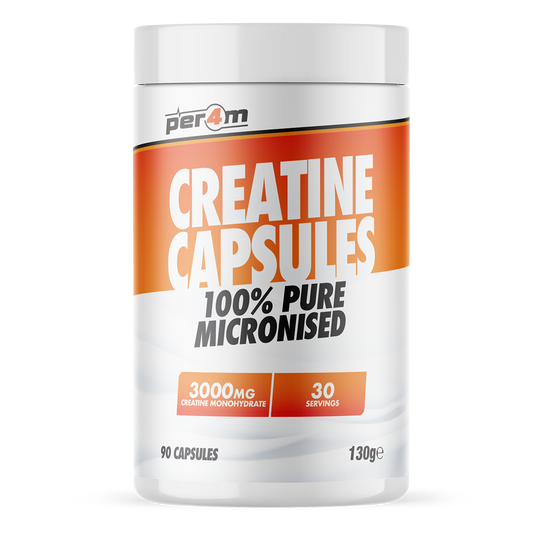
If you’ve been around fitness for a while, you’ve probably heard about creatine. But what is creatine used for, exactly? In simple terms, creatine is a naturally occurring compound your body uses to help produce quick energy during short bursts of high-intensity activity like lifting weights, sprinting or explosive training.
It’s also one of the most researched sports supplements. People commonly use creatine for muscle growth, strength, and training performance – but despite how popular it is, it’s sometimes hard to find a simple explanation of what creatine does and how it works. That’s what we’re going to do right now!
What is creatine in plain English?
Creatine is a substance made from amino acids that your body naturally produces in small amounts. You also get creatine from foods like red meat, fish, and other animal products.
Your body stores most of its creatine inside your muscles, where the creatine can then help your body create energy quickly during demanding physical activity.
Taking a creatine supplement simply increases the amount of creatine stored in your muscles beyond the amount you would have if you only got it from food. That’s why creatine for beginners is often recommended as one of the simplest and most evidence-backed supplements for gym performance.
What does creatine do in the body?

To understand what creatine does, it helps to think about energy production.
Your muscles rely on a molecule called ATP (adenosine triphosphate) for quick energy. The problem is that ATP runs out very fast during explosive efforts.
Creatine helps your body regenerate ATP more efficiently during short bursts of intense activity, like:
- Heavy lifting
- Sprinting
- Jumping
- High-intensity training
In practical terms, that can help support power output, training performance, muscle recovery, and long-term muscle growth, because of your improved training quality.
Creatine itself doesn’t magically build muscle, but it does help support the training performance that leads to muscle growth over time.
How creatine works in high-intensity training

The biggest benefits of creatine usually show up in activities that require repeated bursts of effort – like multiple sets of strength training, sprint intervals, explosive team sports, or any short-duration high-output exercise.
Because creatine helps replenish those rapid energy stores, some people notice:
- Better training performance
- Slight improvements in strength
- They’re able to do more reps or sets
- Improved recovery between sets
This is why creatine explained properly usually comes back to one fundamental thing – it helps you perform hard efforts more effectively.
Creatine isn’t a stimulant and it doesn’t work like pre-workout. You won’t suddenly feel superhuman after one scoop – in fact, you probably won’t feel anything at all. Creatine works by increasing muscle creatine stores over time so you feel stronger, less fatigued, or just able to work a bit harder in training sessions.
Why is creatine monohydrate the standard form?
If you’ve looked at supplements online, you’ve probably seen different creatine variations. Creatine monohydrate remains the standard form for good reason – it’s the most researched, most proven, and most consistently effective version available.
What is creatine monohydrate?
Creatine monohydrate explained is creatine bound with a water molecule. That might sound scientific, but in practice it just means that creatine monohydrate is well-studied, reliable, cost-effective, and usually well tolerated in terms of digestion. Most of the alternative forms of creatine haven’t consistently outperformed standard creatine monohydrate in the research.
Who tends to use creatine?
Creatine supplement use has always been popular with bodybuilders, but there’s so much recent research suggesting it has amazing benefits for recreational gym goers, sports performance, long-term health, and cognitive health.
People who use creatine include:
- Gym beginners
- Strength athletes
- Team sport athletes
- Sprinters
- Cross-training athletes
- Recreational lifters
- People who want muscle retention while dieting
A lot of gym people ask ‘should beginners take creatine or is it just for advanced training?’ For healthy adults starting in the gym, creatine is generally considered one of the more beginner-friendly supplements because the way it works is straightforward and well-researched. That said, supplements should always support good training, nutrition and recovery habits, not try to replace them.
Is creatine just for bodybuilders?
For a long time, creatine was mainly used by bodybuilders and was seen as a bodybuilding supplement. But latest research suggests creatine could help improve mood, memory, cognitive performance, and brain function during sleep deprivation – so it’s becoming widely used inside and outside the gym by a broad range of ages.
Creatine FAQs before trying creatine
Does creatine cause instant muscle gain?
Not exactly, but it does help you train harder which should in turn lead to muscle gain. Some people notice early weight or muscle size increase from additional water stored inside muscle tissue, but actual muscle growth depends on training and nutrition.
Is creatine a steroid?
No, creatine is not an anabolic steroid and works completely differently. Creatine is safe, legal, and well-researched.
Do you need to load creatine?
Loading phases are optional. Some people choose to take around 20g creatine per day for 5–7 days, split into smaller servings, to increase muscle creatine stores faster. But many people simply take 3–5g daily instead. Both approaches are effective. The main difference is how quickly creatine levels in the muscles increase.
Does creatine work for everyone?
Most people respond positively, but response levels can vary depending on your diet, training style, and muscle creatine stores.
Do you need to drink more water on creatine?
Creatine increases water stored inside muscle cells, so it’s important to stay properly hydrated when you take any creatine supplement. Aim for 2–3 litres a day, plus whatever you mix your creatine powder with.
Is creatine safe?
For most healthy adults, creatine is generally considered safe when used appropriately. The most common issues tend to be mild digestive discomfort or temporary water retention.
Can women take creatine?
Absolutely. Creatine is not “just for men” and can support training performance regardless of gender, age, or any other factor.
What is creatine and how does it work?
Let’s recap:
Creatine helps your muscles produce quick energy more efficiently during high-intensity exercise. That can support better training performance, which may help strength and muscle growth over time.
Creatine monohydrate is popular because it’s simple to use, widely studied, effective for many types of training, and newer research shows it may have impressive benefits for healthy ageing and cognitive health, including mood, memory, and brain function during periods of poor sleep.
If you decide to explore creatine further, keeping things simple usually works best – choose a quality creatine monohydrate flavoured or unflavoured to suit you, take it consistently, and have good training and nutrition habits.